

Teacher Training in Pakistan: A Solution to the Country's Education Challenges
Pakistan produces doctors, engineers, and software developers who lead teams across the world. Yet inside the country, over 25 million school-age children are not in a classroom right now. That gap does not happen by accident. It is built, layer by layer, from decisions about funding, policy, and teacher preparation that have been delayed or not acted upon for many years.
According to Pakistan Education Statistics (2023–24/2024–25), an estimated 25.15million children aged 5 to 16 are currently out of school (UNESCO, 2026). To put that in perspective, that is more than the entire population of Karachi. These are not abstract numbers. They are children who will grow up without the foundation to read a prescription, fill out a job form, or help their own children with homework one day.
But the problem goes deeper than enrollment numbers. Even among children who do attend school, the quality of learning remains poor in many areas. And at the center of that quality gap is a persistent, under-discussed issue: the lack of proper teacher training in Pakistan.
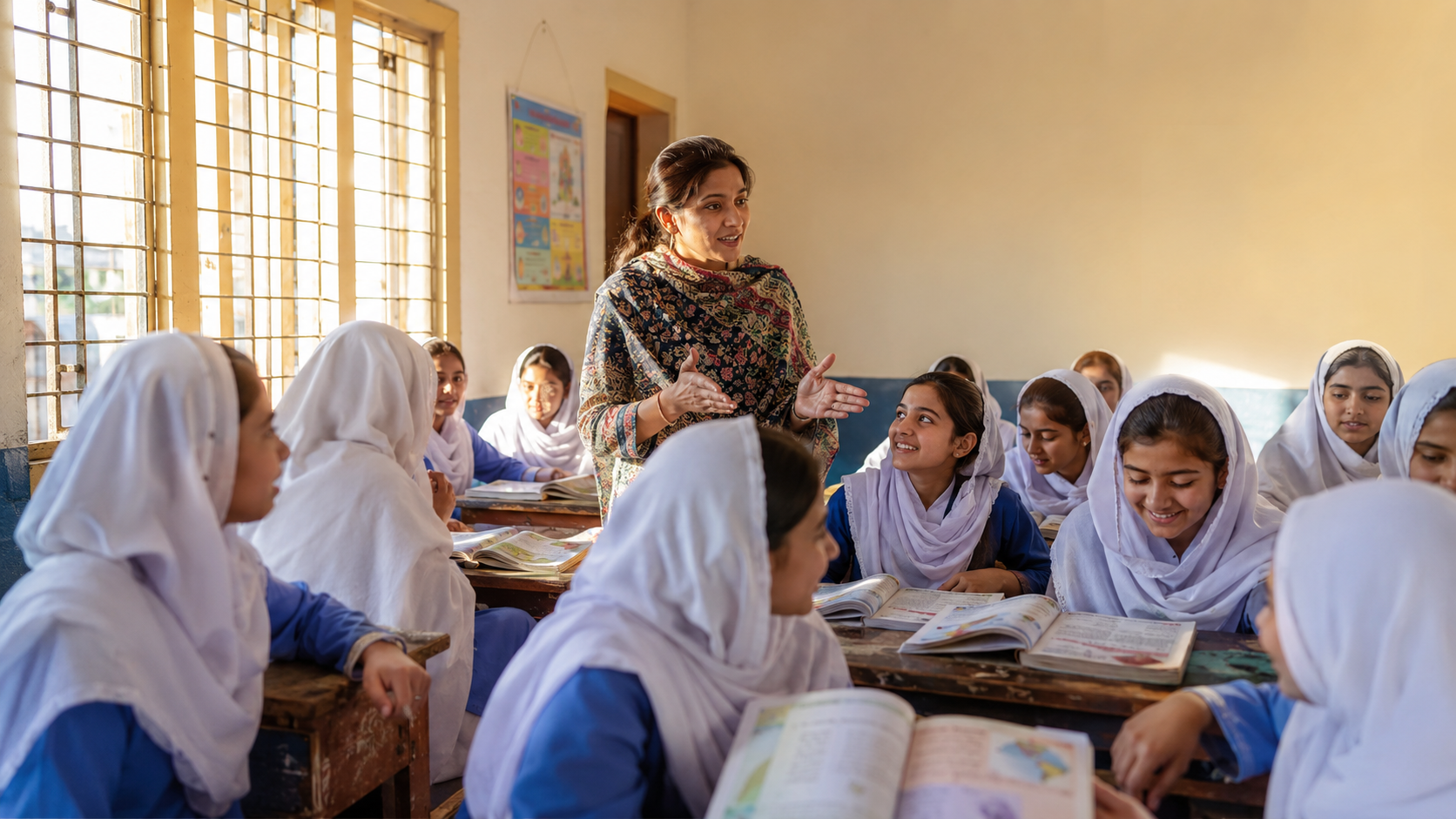
The Key Challenges in Pakistan's Education System
Understanding the scale of the problem requires looking at the root causes, not just the visible symptoms.
Low Education Spending
Pakistan's education budget has dropped to a record low. The Pakistan Economic Survey 2024–25 reports education spending at approximately 0.8 percent of GDP, far below the UNESCO-recommended benchmark of 4 to 6 percent (UNICEF Pakistan). Nearly 90 percent of spending goes toward teacher salaries, leaving almost nothing for professional development, learning materials, or infrastructure improvements. The result is a system where teachers are present but not equipped.
The Teacher Training Gap
Hiring more teachers has not solved the core problem. According to the Asian Development Bank, despite significant increases in teacher hiring since 2019, a shortage of well-trained teachers continues to undermine learning outcomes across Pakistan.
A large-scale survey by Alif Ailaan found that 43 percent of government school teachers received no formal training over five years, and 73 percent had never been offered any courses on assessment techniques during their pre-service preparation. These numbers reflect a teacher education crisis, not just a teacher shortage.
The Gender Gap and Why Female Teacher Training Matters
According to UNICEF, in Sindh and Khyber Pakhtunkhwa, the number of out-of-school girls exceeds that of boys. In Balochistan, 75 percent of girls are missing out on education entirely (Save the Children, 2025).
A major reason this gap persists is not just cultural resistance; it is the absence of trained female teachers. In many rural and conservative communities across Pakistan, families will only allow their daughters to attend school if a female teacher is present. When trained female educators are unavailable, girls simply do not go. This means training more women for the teaching profession is not just a gender equity issue. It is a direct lever for getting millions of girls into classrooms and keeping them there.
Why Teacher Training Is Central to the Solution
It is easy to focus on buildings, books, and budgets. But research consistently shows that teacher quality is the single most powerful in-school factor affecting student learning outcomes.
A trained teacher can manage a large classroom effectively, identify struggling students early, make lessons relevant to local contexts, and keep students engaged enough to stay enrolled. An untrained teacher, no matter how well-intentioned, often falls back on rote methods that push students away rather than drawing them in.
The responsibilities of a teacher go far beyond delivering a lesson. They include building trust with students and families, supporting children through difficult circumstances, and maintaining a learning environment where every child feels they belong. Fulfilling those responsibilities requires proper preparation.
From the Classroom: What Training Actually Changes
Consider a government school teacher in rural Punjab with six years of classroom experience but no formal professional development. Her lessons were quiet and passive. Students memorized content, scored average marks, and moved through the system without gaining real understanding.
After joining a structured teacher training program with practical workshops and monthly follow-up coaching, her approach changed. She introduced group activities, used questioning techniques to check understanding, and began identifying at-risk students before they fell too far behind.
Within one academic year, three previously failing students passed their term exams. Other teachers in her school started observing her classes to learn from her methods.
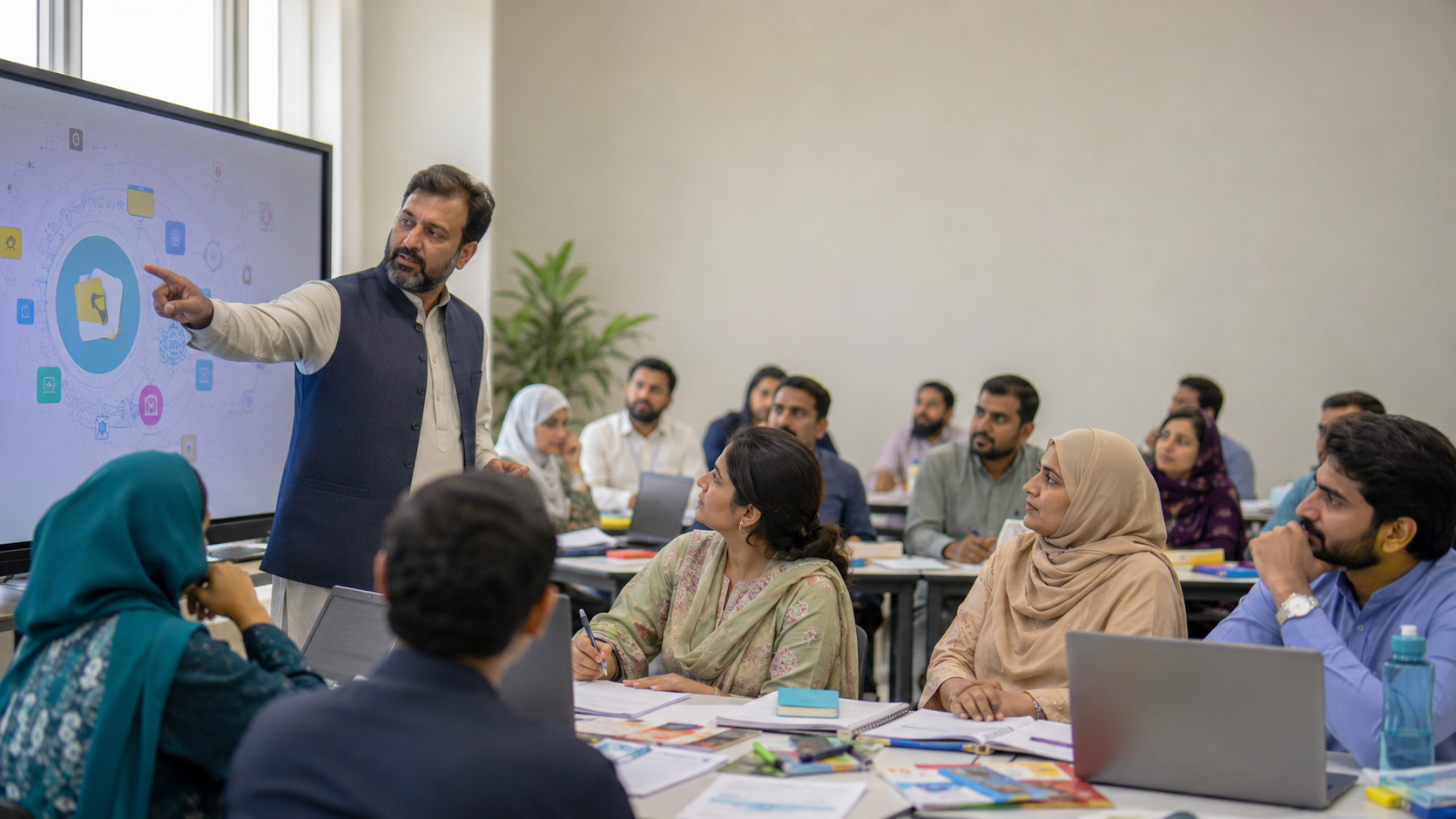
One training program. One committed teacher. Measurable change.
What Effective Teacher Training Looks Like
Not every training program delivers real results. A two-day workshop with no follow-up rarely changes anything. Effective teacher training programs in Pakistan need to include:
Practical classroom skill-building, not just theory. Teachers need to practice managing real scenarios, handling mixed-ability groups, and assessing understanding without always relying on formal exams.
Continuous professional development. One-time courses are not enough. Growth needs to be ongoing, with regular check-ins, mentoring, and peer learning built into the process.
Online and flexible access. Many teachers in Pakistan cannot leave their classrooms for extended in-person training. Online teacher training courses allow educators to learn in the evenings, on weekends, or in short sessions spread over time.
Recognized credentials. When teachers receive formal certification from a reputable teacher training institute, they are far more motivated to complete programs and apply what they learn.
What 1MT Cares Is Doing in Pakistan
1MT Cares works directly with educators in underserved communities across Pakistan, providing structured professional development through programs like the Black Belt Program, the Mastermind Program, and online teaching courses covering everything from foundational pedagogy to technology in the classroom.
In 2026, 1MT Cares hosted its first graduation ceremony in Pakistan, celebrating over 300 educators who achieved the 1MT Black Belt teachers from Lahore, Islamabad, Gujranwala, Peshawar, Okara, and Bahawalnagar, representing diverse institutions with one shared goal: better teaching.
This is what teacher training at scale looks like in Pakistan.
Read Blog: A Proud Moment for Pakistan: 1 MT Hosts Its First-Ever Black Belt Graduation
Frequently Asked Questions
What are the main challenges in Pakistan's education system?
Low public spending on education, a shortage of trained teachers, high out-of-school rates, and deep gender disparities, especially in rural areas, are the most serious challenges.
Why is teacher training important in Pakistan?
Because qualified teachers directly improve learning outcomes, student retention, and community trust in schools. Without proper training, even well-funded schools struggle to deliver quality education.
Are there teacher training courses available online in Pakistan?
Yes. Organizations like 1MT Cares offer structured online teacher training courses accessible to educators across Pakistan, including those in remote areas where in-person programs are not practical.
Conclusion
Pakistan's education challenges are serious, documented, and urgent. But they are not without solutions. The evidence is clear: when teachers receive proper, ongoing professional development, students learn more, stay in school longer, and communities invest more in education. Structured teacher education is not a luxury. It is the most direct path to improving what happens inside every classroom in Pakistan.
If you are an educator, school leader, or institution looking to take teacher development seriously, explore what 1MT Cares offers at www.1mtcares.org
Read Blog: Roles, Duties & Responsibilities of a Teacher: Job Description & How to Be a Good Teacher
