

What is Non-Formal Education: Examples & Importance
A classroom is one place where learning happens. But millions of people, particularly across Pakistan, never get consistent access to one. They learn through community programs, skills workshops, and structured initiatives built entirely outside the formal school system. Non-formal education is the name for this reality, and its significance is far greater than most education conversations give it credit for.
At 1MT Cares, teacher training programs sit at the core of our work, and non-formal education is the framework that makes that work accessible to educators who need it most.
What Non-Formal Education Is
Here is the simplest way to think about it. Formal education has fixed entry points, fixed curricula, and ends with a recognized certificate or degree. Non-formal education has none of those constraints, yet it is still organized, intentional, and produces real learning outcomes.
The difference is in the starting point. Formal schooling asks: what does the system require? Non-formal education asks: what does this learner actually need, and how do we get it to them?
How It Differs from Formal and Informal Learning
Most people move between three types of learning without realizing it. Formal learning is the structured kind found in schools, colleges, and degree programs. Informal learning is the unplanned kind that you pick up from a conversation, an experience, or trial and error.
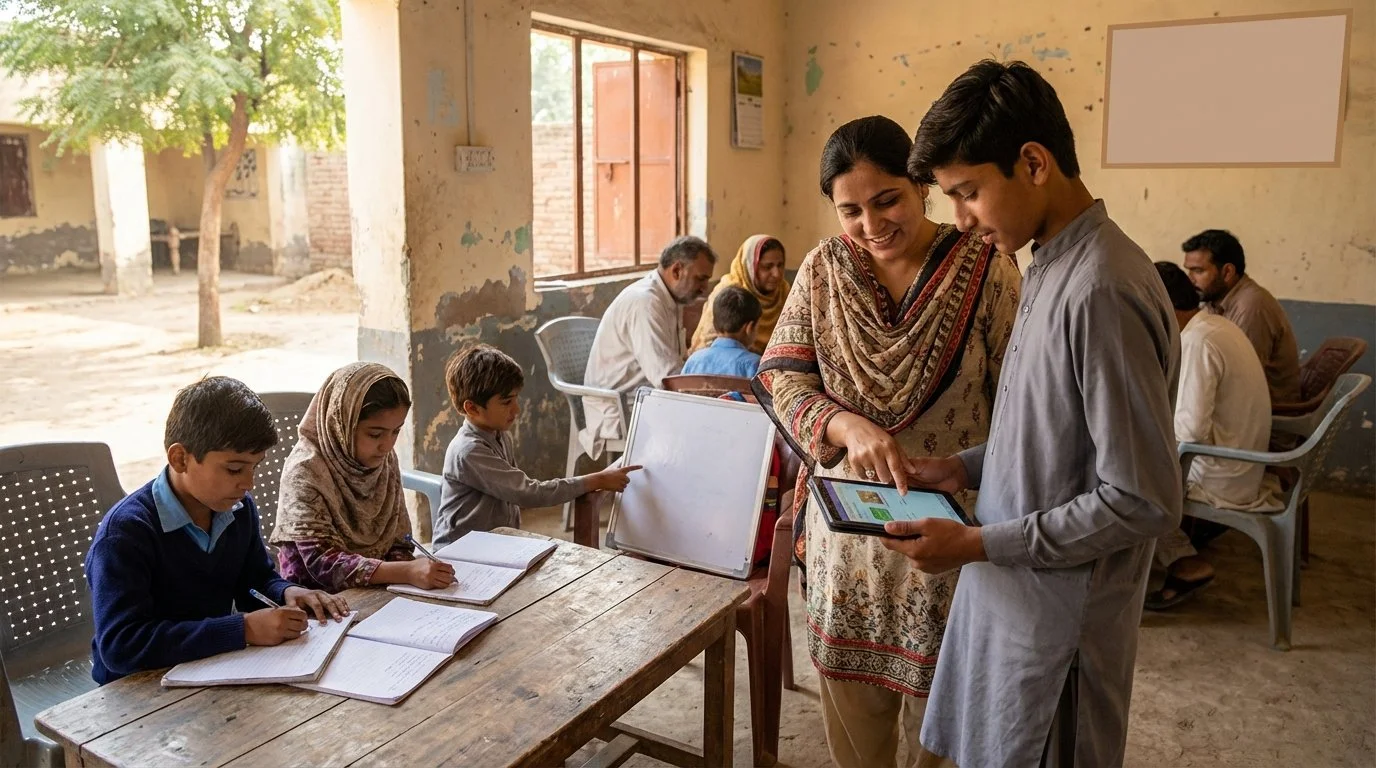
Non-formal sits between them. It is organized and purposeful like formal education, but without the rigid institutional requirements. A weekendteacher trainingworkshop in Lahore. A literacy program running out of a mosque in rural Punjab. An online teaching certification accessed on a basic smartphone. These are not informal; they are structured, goal-directed, and deliberately designed. They just do not fit inside a school building.
Core Characteristics That Define It
Four things consistently define non-formal education across different contexts. It centers the learner rather than the institution. It is designed to remove barriers, such as cost, distance, age, and prior qualifications, not maintain them. It focuses on practical, applicable knowledge rather than theoretical completeness. And it is open: anyone willing to engage can participate.
Those qualities are not accidental. They are responses to a very specific problem: formal systems leave people behind, and non-formal education is built to reach them.
Its Roots and How It Reached Pakistan
The practice of learning outside formal institutions is as old as human civilization, oral traditions, craft apprenticeships, and religious education. What changed in the 20th century was recognition. After World War II, UNESCO and other international bodies began formally acknowledging non-formal education as a strategic response to educational inequality, not just a cultural habit.
Across South Asia, Sub-Saharan Africa, and Latin America, this shift changed how development organizations approached communities where formal schools were inaccessible, underfunded, or absent. Community learning became policy, not just practice.
Where Pakistan Stands Today
Pakistan has a Human Capital Index value of 0.415, below the South Asia regional average of 0.48 and comparable to Sub-Saharan Africa, indicating a serious need for educational reform and greater investment in human capital.Roughly 25 million children aged 5-16 are currently out of school. No formal expansion alone closes that gap in any realistic timeframe. Non-formal education is not a backup plan; here, it is doing the necessary work that the formal system cannot.
Community Learning Centres and Non-Formal Schools
Across Pakistan, community learning centers function as informal schoolhouses where out-of-school children and adults access basic literacy, numeracy, and practical skills without formal enrollment. Organizations have built dedicated non-formal schools in underserved districts specifically targeting children who have already dropped out of the formal system.
Vocational and Skills-Based Training
Tailoring, construction, digital tools, and basic healthcare vocational programs equip learners with marketable skills without requiring years in an academic institution. In communities where the return on a formal degree is distant and uncertain, these programs offer something more immediate: economic participation.
Teacher Training as Non-Formal Education
This one is worth slowing down on. A significant number of teachers across Pakistan's rural and peri-urban areas enter classrooms without structured preparation. Non-formal teacher training programs delivered through workshops, online platforms, or peer learning cohorts provide educators with the pedagogical foundation and classroom skills they need, without requiring them to stop working or relocate. That is non-formal education solving a real, high-stakes problem.
Why It Matters — Practically, Not Theoretically
Rural girls in Balochistan and Sindh. Working children in urban centers. Communities where the nearest school is hours away or is chronically understaffed. Non-formal programs, mobile schools, community learning hubs, and flexible literacy initiatives exist because the formal system has not yet reached these children, and waiting is not a neutral position.
Ongoing Development for Educators
Teacher development should not end at the classroom door. Non-formal education creates structured pathways, including courses, peer communities, and teacher training that fit around active careers. That flexibility is not a compromise. For most working teachers in Pakistan, it is the only version that is actually accessible.
The Teacher Training Connection
Globally, an estimated 44 million additional teachers are needed by 2030 to achieve universal primary and secondary education. Pakistan is part of that shortage. Investing in teacher training courses is therefore not a standalone professional development decision — it shapes whether non-formal education programs produce genuine learning.
How 1MT Cares Works Within This Space
TheBlack Belt Programat 1MT Cares is a self-paced, online teacher-training program designed specifically for educators in low-resource environments. It runs on older devices, works with limited internet, and follows a gamified progression, White Belt through Black Belt, that keeps educators engaged across the full program. Completing it connects teachers to a global peer community and opens access to advanced boot camps facilitated with partners including Queen's University, Girl Rising, and HP.
Read Blog:A Proud Moment for Pakistan: 1 MT Hosts Its First-Ever Black Belt Graduation
Additional programs, GR Courses, and theNABU Course extend this into gender-responsive and inclusive teaching. All of them are structured, intentional, and built for the communities that need them most. That is non-formal education working as it should.
Where This Is Heading
Policy Recognition in Pakistan
Both Punjab and Sindh have developed Non-Formal Education policies in recent years. That institutional recognition matters, it signals that NFE is being taken seriously as a core education strategy, not treated as a workaround. Whether those policies translate consistently into funded, ground-level programs is the harder and more important question.
The Role of Technology
Online teacher training platforms, mobile learning apps, and community digital hubs are not replacing non-formal education. They are extending their reach into areas where in-person delivery was never viable. For1MT Cares, technology is the delivery mechanism, not an add-on. It is what makes teacher training courses accessible in the most remote parts of Pakistan.
Conclusion
Non-formal education is not a consolation prize for people who missed formal schooling. It is a deliberate, structured response to a very real gap, one that Pakistan, given its education challenges, cannot afford to treat as secondary.
At 1MT Cares, that gap is where we work. Expanding access to quality teacher training programs is how we do it because an empowered educator changes what is possible in a classroom, a community, and eventually, across an entire system.
Also Read: What Is Formal Education? Types and Benefits
