

Good teaching has never depended on a projector. In schools without technology, learning still happens when a teacher knows where each child stands, uses what is at hand, and keeps the class actively thinking.
This guide explains what teaching with little or no technology involves, which methods have evidence behind them, and how teachers can keep building their skills when resources are thin.
What Teaching in Schools Without Technology Looks Like
For many teachers, “no technology” is not a choice. It is the daily reality. According to UNESCO’s 2023 Global Education Monitoring Report, only 40% of primary schools worldwide are connected to the internet, compared with 65% of upper secondary schools. The youngest learners are often the least connected.
Pakistan shows the same pattern. Provisional findings from the ASER Pakistan 2023 rural survey found that 73% of rural schools had electricity, but only 15% had internet access. A teacher in such a school may have a chalkboard, a few textbooks, and a crowded room.
It is worth being clear about who sits in these classrooms. Most students are not people who don’t use technology by choice. They simply lack access. A teacher’s job is to make sure that gap in devices does not become a gap in learning.
Why a Tech-Free Classroom Can Still Deliver Strong Learning
Technology can help, but it is not what makes learning work. The same UNESCO report warns that learning benefits disappear when technology is overused or used without a qualified teacher. The teacher, not the tool, is the deciding factor.
A tech-free classroom also has some practical strengths:
Fewer distractions: attention stays on the lesson, the teacher, and classmates.
More talk and interaction: discussion, questioning, and group work fill the space that screens might take.
Lessons that travel: methods built on paper, voice, and local materials work in any classroom, with or without electricity.
Practical Tips for Teaching With No Technology
Assess and Group Students by Learning Level
In many low-resource classrooms, students in the same grade read and calculate at very different levels. A quick oral or paper-based check, such as asking each child to read a short paragraph or solve two sums, shows where everyone stands.
Group students by learning level for part of the day, not by age or grade. This is the core of Pratham’s Teaching at the Right Level approach. J-PAL reports that six randomized evaluations in seven Indian states found it raised test scores, and that tailoring instruction to learning levels was among the most cost-effective ways to improve learning. It needs no devices, only planning and regular checks.
Turn Everyday Materials Into Teaching Aids
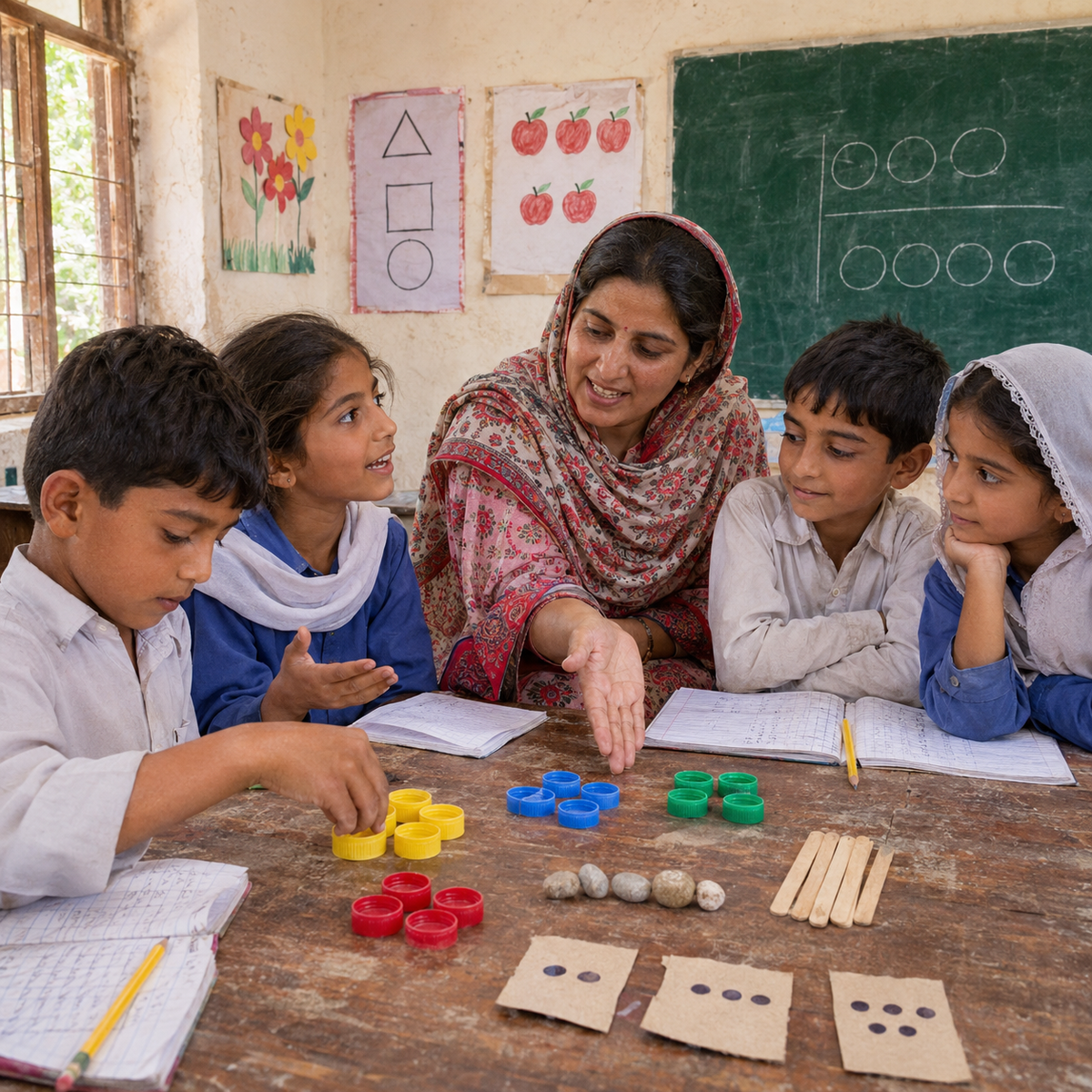
Low-cost and no-cost materials can make abstract ideas concrete:
Bottle caps, stones, or sticks for counting, grouping, and fractions.
Old newspapers and packaging for reading practice and vocabulary hunts.
Leaves, soil, and water for simple science observations.
Hand-drawn charts and flashcards made with students, which can be reused for years.
When students help make the materials, they also take ownership of the learning.
Let Students Teach Each Other
Peer learning stretches one teacher’s reach in a crowded room. Pair a confident reader with a struggling one, or let small groups explain a solution to the class. The student who explains deepens their own understanding. The student who listens hears the idea in simpler language.
Make the Chalkboard Work Harder
The chalkboard is the most reliable tool in a classroom without technology. Divide it into fixed zones, such as the lesson objective, key words, worked examples, and practice questions. Students then always know where to look. Leave worked examples up long enough for slower writers to copy them.
Keep Routines Simple and Consistent
Without digital tools to manage time and attention, routines do that work. A consistent way to start class, a clear attention signal, and a calm response to disruption save valuable minutes. These core classroom management skills matter even more when every minute of contact time counts.
A Real Example: One Computer, 58 Students per Teacher
Peter Tabichi, a maths and science teacher in rural Kenya, won the 2019 Global Teacher Prize. His school, Keriko Mixed Day Secondary School in Pwani Village, had one computer, poor internet, and a student-teacher ratio of 58 to 1. He and four colleagues gave low-achieving students one-to-one tuition outside class, and he visited families to understand what was holding students back.
The lesson for other teachers is that limited resources did not lower his expectations. He focused on relationships, extra practice, and knowing each learner, which are things no budget can buy.
How 1MT Supports Teachers in Low-Resource Classrooms
Teachers in under-resourced schools need support that fits their reality. 1MTCares focuses on this, working with teachers in vulnerable and under-resourced communities in Pakistan and Sub-Saharan Africa.
Its Black Belt Program is built for teachers with limited access to technology. The program is self-paced and optimized for low bandwidth and older devices, so teachers in remote areas can train without a computer lab or fast connection. Teachers move from White Belt to Black Belt and join a peer community where they share strategies that work in their own classrooms.
The model is growing in Pakistan. In 2026, 1MT held its first Pakistan graduation, celebrating more than 300 educators who earned their Black Belt. If you are comparing options, this guide to choosing a teacher training institute explains what to look for before you enroll.
Final Thoughts
Teaching without technology demands more planning and creativity from teachers, and it can still produce real learning. The strongest resource in any classroom is a well-trained, well-supported teacher. If you teach in a low-resource school and want to keep growing, the 1MT Black Belt Program offers a flexible place to start.
