

A good teacher training institute does more than just give you a certificate. It helps you develop teaching skills, build confidence, and connect with other teachers. The real challenge is choosing the right institute from so many options.
This guide explains what teacher training programs cover, how to compare them, and why many educators in Pakistan trust 1MT Cares.
What Does a Teacher Training Institute Do?
A teacher training institute prepares educators in pedagogy (the methods and principles of teaching), lesson planning, classroom management, assessment, and professional ethics.
Teacher education in Pakistan generally runs on two tracks. Pre-service programs, such as the B.Ed., prepare people before they enter the classroom. In-service teacher training courses help working teachers upgrade their skills. Short certificates, workshops and online teaching courses sit alongside both.
Pakistan has developed National Professional Standards for Teachers, and the Higher Education Commission’s teacher education roadmap includes different B.Ed. streams. degree. Minimum requirements also vary by province, with some provinces requiring a professional qualification and others not, so confirm what your target job requires. thenews
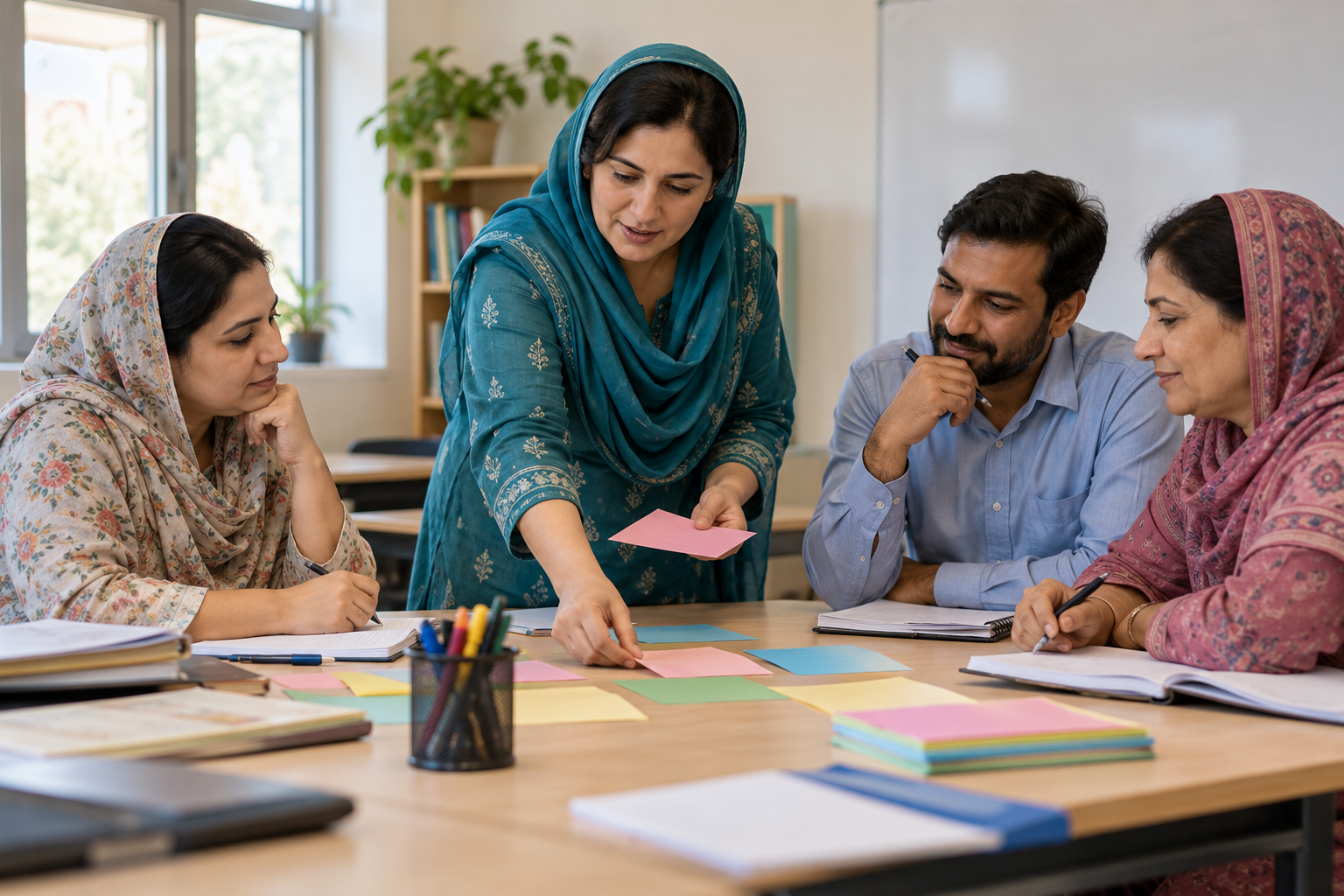
Why the Choice Matters
The global picture shows why teacher preparation deserves attention. UNESCO’s Global Report on Teachers projects a deficit of 44 million primary and secondary teachers by 2030, including 15 million in sub-Saharan Africa. The same report found that attrition among primary teachers almost doubled between 2015 and 2022, from 4.62 to 9.06 per cent, with teachers often leaving within their first five years. teachertaskforceun
These figures do not prove that training alone keeps teachers in classrooms, but they show that preparing and supporting teachers is a central issue worldwide. For an individual teacher, the practical lesson is to choose training that keeps supporting you after the first course ends.
How to Choose the Right Teacher Training Program
Which teacher training course is best? It depends on your stage and your goal. Compare options on these points:
Curriculum depth: Look for pedagogy, classroom management, assessment, inclusive teaching, and digital skills, not theory alone.
Recognition: Ask the school or employer you hope to join which qualification they accept.
Flexibility: Working teachers need self-paced or online options.
Practical application: Good programs ask you to try ideas in a real classroom.
Community and progression: Peer support and clear next steps matter after completion.
Transparency: Credible institutes publish program details, partners, and impact reports.
Before enrolling, ask the institute a few direct questions. Who designed the courses, and who teaches them? How is progress assessed? What support exists once you finish? Clear, specific answers are a better sign of quality than a long list of course titles.
| Option | Best for | Keep in mind |
|---|---|---|
| B.Ed. degree | A formal entry qualification | Takes years; university programs run from a minimum of 2.5 years to 4 years |
| Short certificate or in-service course | Upgrading specific skills | May not replace a degree where one is required |
| Online teaching certification | Working adults and remote learners | Confirm employer acceptance first |
Are Online Teaching Courses Worth It?
For many teachers, yes. Online teacher training courses remove the cost and travel of a campus and let people study around work and family. Online teaching courses work best when they include community support and practical tasks, not just videos. The limit is recognition: when a job requires a B.Ed. or another formal degree, an online certificate complements the degree rather than replacing it.
Teacher training also suits people changing careers. Many first-time teachers start with a skills-focused course in lesson planning and classroom management, then decide whether a longer qualification is worth pursuing.
Experienced teachers use the same courses to refresh their methods and learn newer tools such as digital teaching resources.
Why Teachers Trust 1MT Cares
1MT Cares is a registered organization that empowers teachers in under-resourced communities through teacher training programs in Pakistan and sub-Saharan Africa. Its signature offering, the Black Belt Program, is built around the realities teachers face:
Self-paced online learning, so teachers can study around work, family, and community duties.
Low-bandwidth design, with modules that work on older devices and limited internet.
Gamified progress, as learners move from White Belt to Black Belt and earn badges at each milestone.
Community and lifelong access, including an online peer community and free lifetime access to the 1 Million Teachers platform.
Pathways forward, since completing the program opens boot camps and workshops with partners such as Queen’s University, Girl Rising and HP, and graduates can mentor others through paid teaching opportunities.
If you are unsure where to begin, this overview of which 1MT program fits your stage as a teacher helps match your experience to the right pathway.

A Real Example: Pakistan’s First Black Belt Graduation
In 2026, 1MT hosted its first graduation ceremony in Pakistan, celebrating more than 300 educators who earned the Black Belt. They came from institutions including APS Okara, APS Bahawalnagar, Sanjan Nagar School System in Lahore, and Shah International School in Peshawar. The event shows that teachers from schools in several cities completed the same pathway, which builds a professional community across institutions rather than isolated individual effort.
Making Your Decision
Start with your goal: a formal qualification, a skills upgrade, or a career change. Check what your employer requires, then choose training that fits your schedule and keeps supporting you afterwards. To understand the wider pressures behind the demand for trained teachers, read about how teacher training responds to Pakistan’s education challenges. When you are ready to begin, explore the Black Belt Program at 1MT Cares.
FAQs
Which teacher training course is best?
The best course is the one that fits your goal, schedule, and employer requirements. For a formal qualification, a B.Ed. is the usual route. For flexible skill-building, the 1MT Cares Black Belt Program offers self-paced online learning, from foundational pedagogy to advanced teaching strategies, with a supportive teacher community.
Can I become a teacher at the age of 40?
Yes, many people move into teaching later in their careers. Training builds skills rather than depending on age, but some recruitment posts may list their own age criteria, so read each job advertisement. A self-paced program like 1MT’s Black Belt lets you study around existing work and family commitments.
Are online teaching courses recognised in Pakistan?
Recognition depends on the employer or institution. Online certificates build skills and show professional development, but some roles require a B.Ed. or another formal degree. Confirm the requirement before enrolling, and treat online certification as a complement where a degree is mandatory.
How long do teacher training programs take?
It varies. University B.Ed. programs run from roughly 2.5 to 4 years, while short certificates take less time. The 1MT Black Belt Program is self-paced, so you move from belt to belt at your own speed.
What is the difference between pre-service and in-service teacher training?
Pre-service training, such as a B.Ed., prepares you before you start teaching. In-service training upgrades the skills of working teachers through courses and workshops. Many teachers combine both over a career, and 1MT’s continuing education offerings serve teachers already in the classroom.
