

Classroom Management Skills Every New Teacher Needs & How 1MT Trains for Them
Ask any new teacher what surprised them most about teaching, and many will give the same answer: it wasn’t the lesson plans, but managing the classroom. Keeping 20 or 30 students focused, calm, and ready to learn is a skill of its own. Effective classroom management is just as important as knowing the subject being taught.
Research from the National Council on Teacher Quality found that 58% of teachers deal with behavior issues every single day, and 52% say managing student behavior is their top source of work stress. That's not a small classroom problem. It's the single biggest reason new teacher training exists in the first place.
What Is Classroom Management, Really?
Classroom management is how a teacher organizes a room, sets routines, and responds to student behavior so that learning can actually happen. It covers everything from how a lesson starts to how a teacher handles a student who's off task, and it works best when it's planned ahead of time rather than figured out in the moment.
Good classroom management is not just about discipline. A 2021 review of teacher research published by Edutopia found that student confusion can account for about 20% of classroom misbehavior. In simple terms, some behavior that looks like “bad behavior” may actually come from students who do not understand the lesson. This is why effective teacher training should focus not only on discipline, but also on clear teaching and helping students understand the lesson.
How 1MT Cares Approaches Teacher Training
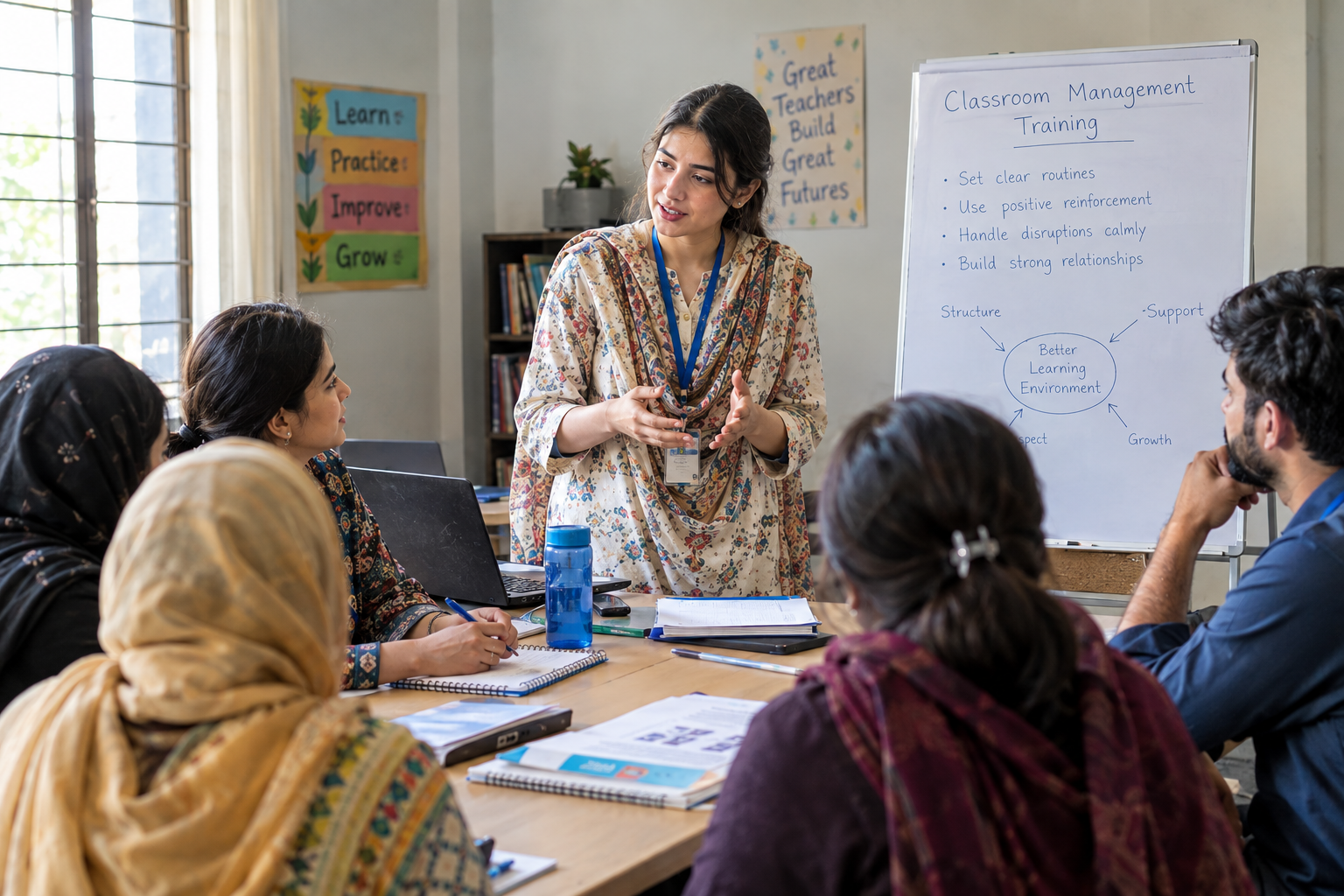
1MTCares, working across Pakistan and Sub-Saharan Africa, treats classroom skills as something to build step by step, not something a teacher should figure out alone. Its Black Belt Program walks teachers through structured levels of practice, similar to a martial arts belt system, so skills like routines, positive reinforcement, and calm redirection get practiced and reviewed, not just discussed once in a workshop.
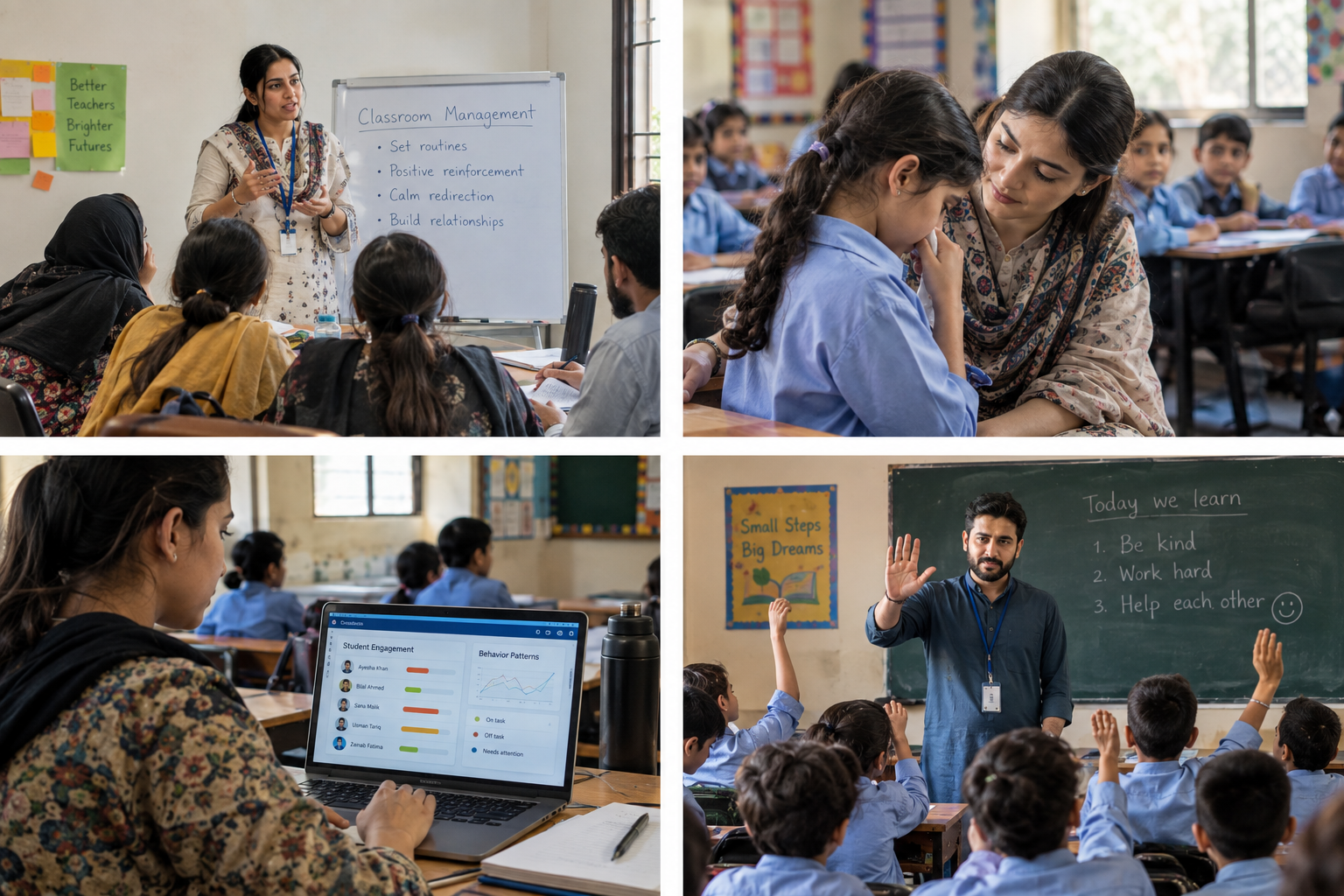
For teachers who want to learn more, the AI for Educators course shows how technology can support better classroom management. These tools can help teachers track student participation and identify behavior patterns early. AI does not replace a teacher’s judgment. Instead, it gives teachers useful information to help them make better decisions.
If you're weighing which path fits where you are in your career, 1MT Cares Explained: Which Program Fits Your Stage as a Teacher? breaks that down by experience level rather than assuming every teacher needs the same starting point.
What to Look For in a Credible Training Program
Not every course labeled "teacher training courses" delivers the same thing. Before enrolling, it helps to check for:
Practice, not just lectures: Do you get to rehearse routines, or only hear about them?
Ongoing follow-up: Is there mentoring after the initial course, or does it end there?
Real classroom examples: Does the training use actual teaching situations, or only theory?
Recognized outcome: Does completing it lead to a teaching certificate in Pakistan or a documented credential?
Read Blog: 10 Topics To Include in Professional Development Training For New Teachers
A Real Classroom Example
A first-year elementary teacher, Ms. McErlain, shared her experience in an Edutopia article. At the start of the school year, she faced the common challenges of managing a new classroom. To create a more positive environment, she introduced a simple social-emotional routine using a classroom mascot called “Penny the Positivity Penguin.” This helped students take part in regular check-ins without feeling like they were being punished.
The value of this routine became clear when a student came to her in tears after being excluded by classmates. Instead of ignoring the situation, she stopped, asked the student if they wanted a hug, and involved the school counselor. This was more than a classroom discipline technique. It showed how regular teacher training and practice can help teachers respond calmly and effectively when students face difficult situations.
Technology's Growing Role in Classroom Management
More schools in Pakistan are asking teachers to teach in blended or online settings, which means the old rules of "keep the room quiet" don't fully apply anymore. Teacher training programs are starting to fold in digital tools, seating and grouping apps, participation trackers, and simple AI tools that flag which students are falling behind before it becomes a bigger issue.
One first-year teacher's own account, published on Edutopia, described using a classroom mascot and a social-emotional check-in routine to defuse a bullying situation before it escalated not a tech tool, but the same underlying principle: catch the small problem early, before it becomes a discipline case. Training that only covers "rules and consequences" misses this earlier layer.
How Can New Teachers Build Classroom Management Skills Fast?
Start with routines, not rules. A new teacher can improve classroom control fastest by fixing three things first: a consistent way to start class, a clear signal for attention, and a calm, practiced response to the most common disruptions rather than trying to memorize a long list of consequences.
This is where management skills separate a confident classroom from a chaotic one. Teachers who practice a small number of routines until they're automatic tend to spend less energy on discipline and more on actually teaching, which lines up with why classroom behavior management training works best when it's repeated, not delivered once and forgotten.
For teachers newer to the profession, effective classroom management strategies for new teachers usually start smaller than expected: one seating plan, one attention signal, one way to open class. Programs built for teacher education in Pakistan increasingly teach it this way: a few strong habits done consistently, instead of a long list nobody remembers by week two.
The Value of Ongoing Training
Pakistan's Human Capital Index sits at 0.415, below the South Asia average of 0.48, according to World Bank data cited by 1MTCares, a reminder that investment in teacher preparation still has real room to grow nationally. Structured, ongoing training courses for teachers are one practical way that gap gets narrowed, classroom by classroom.
None of this means training guarantees a perfectly smooth year; no course can promise that. But teachers who get real practice, follow-up support, and a chance to review what worked tend to build steadier, calmer classrooms over time. For anyone curious about what a specific program covers, 1MTCares' program pages are there to explore at your own pace no pressure, just information.
FAQ’s
How do I improve my classroom management?
Pick one routine to open class, one signal for attention, and one calm response for disruptions. Practice them until they're automatic.
How do I manage bad behaviour in the classroom?
First, check whether it's really defiance or just confusion. Redirect calmly, stay consistent, and reinforce good behavior too, not just the bad.
How do I improve my teaching methods?
Get honest feedback from a mentor or colleague, and change one thing at a time instead of everything at once.
Which method is good for teaching?
No single method works best. A mix of clear instruction and active student participation usually works well.
How can I improve my teaching style?
Practice, get feedback, and adjust pacing or tone gradually. Your style settles in over time, not overnight.
Which organization can provide teacher training in Pakistan?
Government Teacher Resource Centers offer training, and nonprofits like 1MT Cares run structured programs such as the Black Belt Program.
