

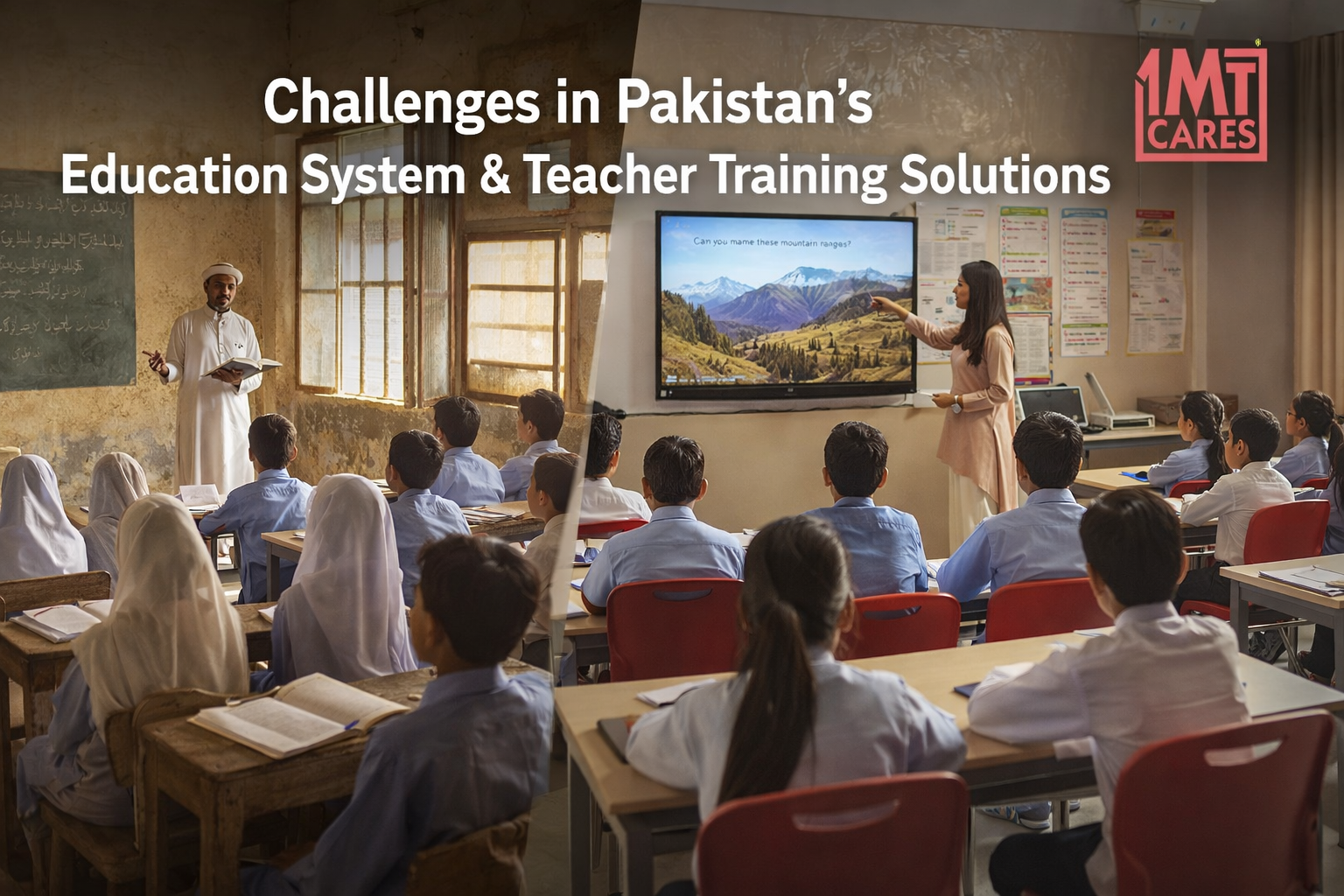
Challenges in Pakistan’s Education System & Teacher Training Solutions
If you look at Pakistan’s education system closely, you’ll see a mix of progress and pressure points. Yes, more children are enrolled in school today than a decade ago. But enrollment alone doesn’t tell the full story. The bigger question is: are students actually learning, and are they staying in school long enough to build real skills?
Policies are drafted, revised, and announced. Yet when you step inside many classrooms, the reality feels slower to change. That gap between paperwork and practice is where most challenges sit.
Current literacy rate and access gaps
Pakistan’s literacy rate is slightly above 63%. On paper, that may look like an improvement. In practice, the numbers vary widely depending on where you live.
Urban areas tend to perform better. Schools are easier to access, and facilities are comparatively stronger. In rural regions, especially remote districts, the situation is different. Fewer schools, limited transport, and teacher shortages make consistent learning difficult.
Girls face even greater barriers in some communities. Family responsibilities, financial stress, or long travel distances often interrupt their education. So while access has expanded, staying in school and learning effectively remains a serious concern.
Simply opening more schools isn’t enough. Quality and continuity matter just as much.
Public vs private school divide
The divide between public and independent schools is another visible reality. Most students attend government schools, especially those from low income families. Overcrowded classrooms and inconsistent supervision can impact performance.
Even low cost private schools are seen as being more academically focused or disciplined. The cost of attending these schools limits their accessibility. This creates a parallel system where opportunities are often dependent on income.
To reduce this imbalance, it is necessary to improve teacher standards and accountability in both sectors, not just one.
Key Challenges in Pakistan’s Education System
1. Teacher Shortage & Qualification Gaps
At the heart of the system stands the teacher. When teachers are well prepared and motivated, students benefit. When support is weak, learning suffers.
In several rural districts, schools operate with unfilled teaching positions. Some educators manage multiple grades at once. It’s demanding, and it reduces the attention each child receives.
Limited professional certification pathways
Teacher qualification processes are not fully uniform nationwide. Different provinces follow different recruitment and certification rules. Not every teacher goes through a structured licensing or competency assessment process.
Most pre-service training programs are heavily theory-based. New teachers often struggle when they enter classrooms with issues such as lesson pace, discipline management, or adapting to mixed ability groups.
Teachers should be prepared for real-life situations, not just theoretical concepts.
Uneven standards of teacher training
Short seminars are often used for in service professional training. Although they are useful, there is rarely any follow up. It's easy to get stuck in old routines without mentoring or observation.
Consistency is the missing piece. If training standards vary widely, classroom quality will vary too.
2. Curriculum & Policy Gaps
Curriculum reform is frequently discussed in Pakistan. Implementation, however, is where complexity begins.
Implementation issues in the Single National Curriculum
The Single National Curriculum was introduced to create uniform learning expectations. The idea was to reduce disparities across different educational streams.
But rolling out a curriculum is one thing; preparing teachers to use it effectively is another. Many educators needed a deeper orientation and practical workshops to understand new objectives and teaching approaches.
Updating textbooks without updating teaching strategies limits the impact of reform.
3. Infrastructure & Funding Issues
Facilities and funding levels quietly shape learning outcomes.
Rural urban disparity
Infrastructure is generally stronger in urban schools. Rural schools may, on the other hand, lack adequate materials and classrooms with stable or functional electricity.
The patterns of teacher deployment also play a part. Many experienced educators prefer to work in urban areas, which leaves rural institutions with a shortage of staff. This leads to a widening of performance gaps over time.
Teacher Training Solutions for Sustainable Reform
If reform is the goal, teacher development has to be central. Systems improve when educators are equipped, supported, and evaluated constructively.
1. Continuous Professional Development (CPD)
Professional learning should not end after initial certification. Teaching evolves, and so should teachers.
Skill-based certification programs
Clear benchmarks build consistency and credibility. Professional development programs offered by organisations such as 1MTCARES focus on classroom application skills. Targeted, practice-oriented training helps teachers feel more prepared to face real-world challenges.
Classroom Management & Assessment Training
Effective classroom management creates space for learning. Teachers need to understand formative assessment, which involves evaluating students throughout the learning process, not just at the final exam.
1MTCARES, for example, offers modules that focus on discipline and evaluation.
2. Integration of Educational Technology
Digital pedagogy training
Digital pedagogy means designing lessons that effectively use technology. Some training providers, including 1MTCARE, now integrate digital teaching strategies into their programs.
When teachers feel comfortable blending technology with subject content, engagement improves naturally.
3. Quality Assurance & Global Frameworks
Reform also depends on structured evaluation and standards.
Adoption of standards inspired by UNESCO
Global frameworks developed by UNESCO highlight teacher competencies, inclusion, and measurable learning outcomes. Carefully adapting such principles can strengthen national quality benchmarks.
Performance evaluation & mentoring systems
Performance reviews should not be a source of fear, but rather a tool to improve performance. Mentoring programs provide experienced teachers with the opportunity to help newcomers in their early careers.
1MTCARES, a professional training provider, and public institutions can form partnerships to create structured mentoring paths aligned with national priorities.
Read Blog: Teacher Training in Pakistan (2025 Guide): Programs, Courses, Certificates & Requirements
Conclusion: Strengthening Pakistan’s Education Through Teacher Empowerment
Pakistan's education problems are complex, from staffing shortages and curriculum implementation to infrastructure gaps. There isn't a single solution.
It is the steady investment made in teacher development that makes a real difference. When teachers receive constant training, practical advice, and supportive assessment, classroom standards slowly rise.
Policy reform combined with meaningful teacher development can move the system forward. And when teachers grow, students and ultimately the nation grow with them.
